- Test payment
- EUR 20.00
- Declared MCC
- 5399 — misc. retail
- Delivered
- Online gambling — MCC 7995 required
- Descriptor
- SP *DGTLSRV0417
- Front shop
- novavisto.example — EE
- Acquiring BIN
- 400000
- Acquirer
- Orchestrator
- Settlement route
Secret buyers for the payment rails
We buy from the illegal operators you can't see.Then we tell you who banked them.
Illegal casinos hide behind clean-looking merchant accounts. We sign up, deposit real money, and follow it — to the descriptor, the acquiring BIN, and the bank processing for them.
We process no payments — we take no revenue from any party we investigate
- EUR 91.6bnIllegal online gambling GGR targeting EU consumers, 2025ECA / GCI, 3 Jul 2026
- EUR 18bnThe industry's own lower estimate — 27% of EU online GGREGBA, 27 Mar 2026
- 6,200+Operators targeting EU consumers without a local licenceECA / GCI, 3 Jul 2026
- USD 400,000Maximum Visa assessment per merchant or URL for processing illegal transactionsVisa Integrity Risk Program
The two estimates differ on methodology, not on direction. Nobody publishes how much of this runs on cards.
The problem
The laundering is of merchant identity, not money.
An illegal operator does not need to move dirty money. It needs a clean-looking merchant account. The site sells gambling. The merchant record says general retail. The payment settles anyway.
The tools to block exist. The visibility to aim them does not.
For example, for card payments it may appear that the card payer is purchasing beauty products instead of gambling services. This arrangement means that payment service providers cannot see that the card payments are for gambling and therefore cannot reject the transactions as specified in the Gambling Ordinance.
Illegal operators exploit weaknesses across the payments chain – among payment service providers, acquirers, and card networks – to keep reaching European consumers.
The card rail is a decision they make about you
Same site. Same minute. Cards appear only for the right visitor.
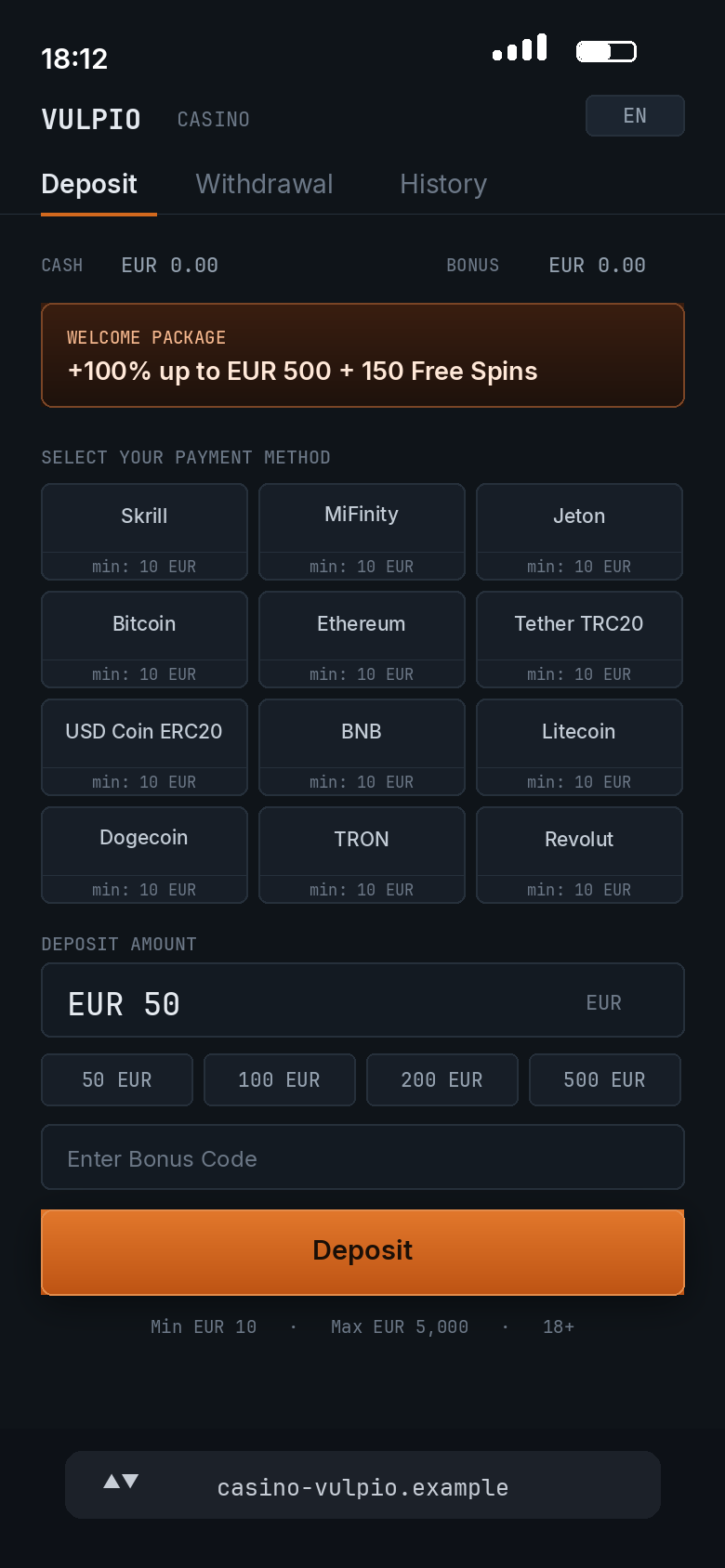
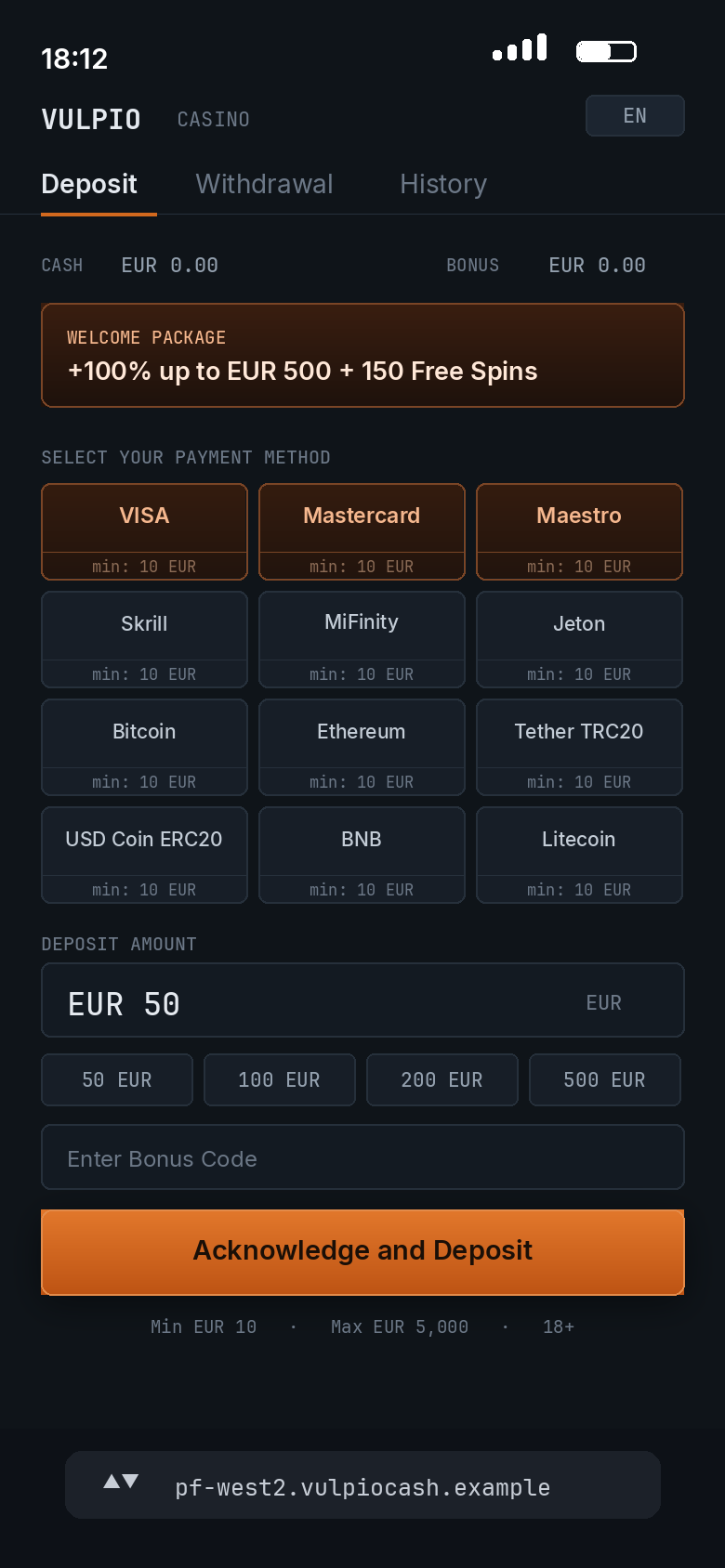
Crawl it from a data centre and you find a crypto-only casino. The card option is served to targeted traffic only, and it settles under a declared MCC of 5399 where 7995 is required.
The receipt
The only place the truth surfaces.
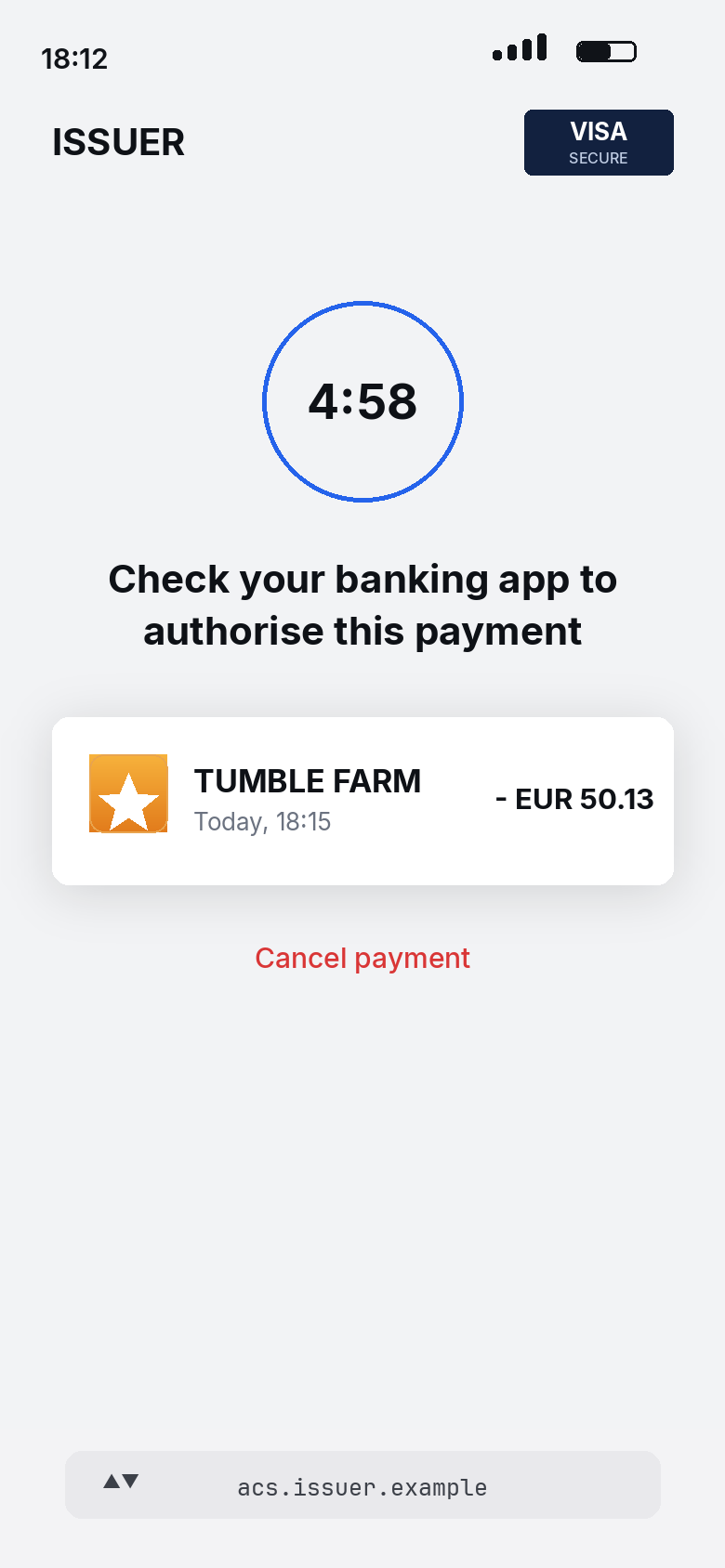
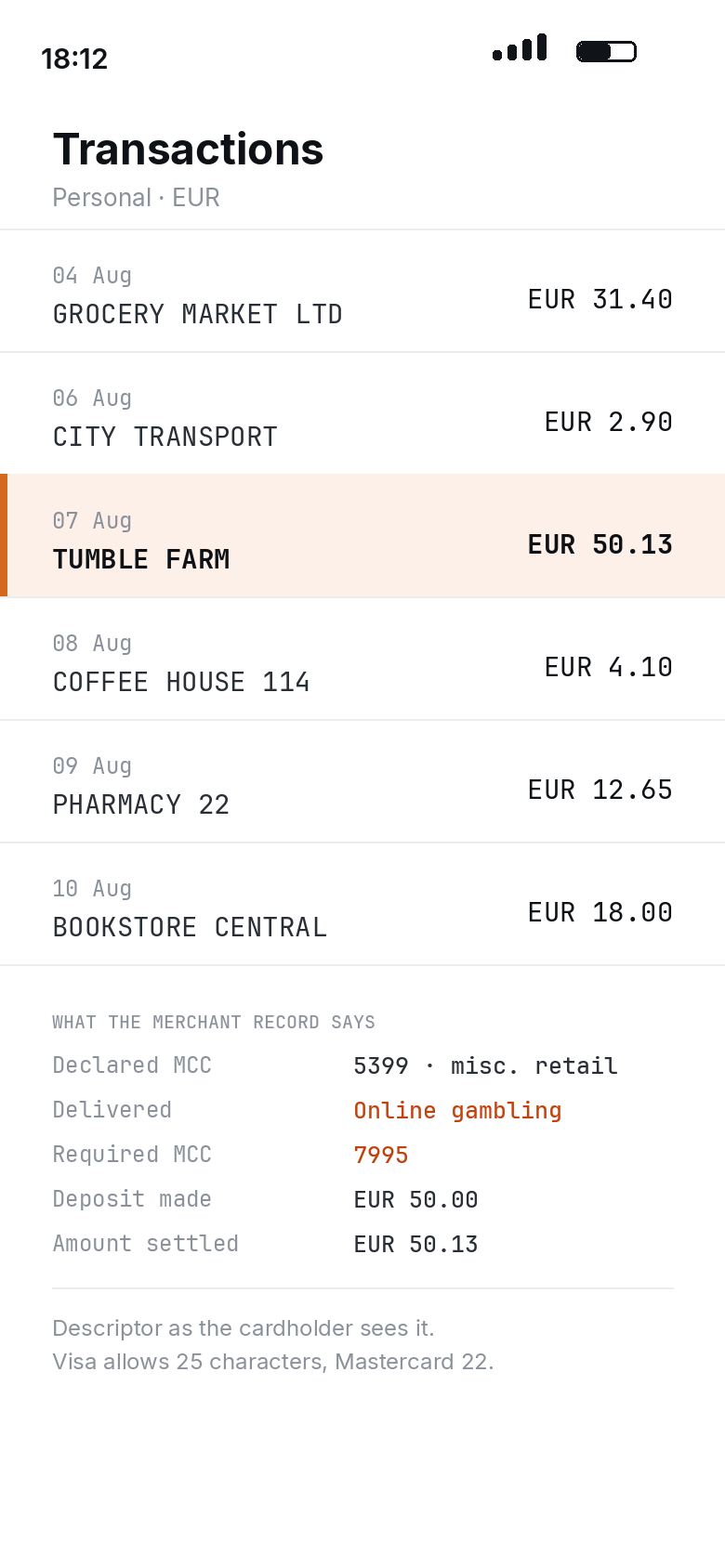
The authorisation prompt reads SP *DGTLSRV0417, EUR 0.13. A name that means nothing, and thirteen cents that do.
Specimen record — values synthetic and illustrative
A shell changes its name, its descriptor and its storefront overnight. Changing the institution that acquires for it is slow, expensive and visible. That is the fact we sell.
The rule
The rule is already written. It is simply unenforceable.
If the Merchant conducts online gambling transactions, it must use MCC 7995 for all transactions, even if gambling is not the Merchant's primary business.
The Acquirer must ensure that each Merchant … is identified in authorization and clearing Transaction messages with the Acceptor business code (MCC) that reflects the primary business … Any Transaction that includes the sale of products or services properly identified with one of the following MCCs must be identified with such MCC: • Gambling Transactions (MCCs 7800, 7801, 7802, 7995, and 9406)
Acquirers must prohibit agents from utilizing dynamic Merchant descriptors for Gambling Merchants.
the most common violations identified during a BRAM investigation are: … Section 5.8.1 'Acceptor Business Code (MCC) Information' … An Acquirer deemed to be in violation … may be assessed, with respect to each Merchant … USD 200,000 or USD 2,500 per day, retroactive to the first day of the noncompliant practice
Both schemes already require the correct code. Neither can see when it is wrong without somebody buying.
Method
Five steps. Bounded, documented, repeatable.
- 01
Target
A priority list built from proactive targeting and a tip channel open to members and the public.
- 02
Onboard as a real customer
Native-language entry through the affiliate funnel, with correct geography and device signature. Auditors get served the decoy.
- 03
Pay, capped and documented
A small real payment under a strict cap, with a full audit trail.
- 04
Trace the settlement path
The acquiring BIN. The descriptor as it lands. The orchestrator in the middle. The settlement route.
- 05
Package to evidentiary standard
Chain of custody on every artifact. Timestamped, reproducible, formatted for compliance-programme intake.
You cannot buy from your own licensee — evidence generated inside your own network is the first thing opposing counsel impeaches.
Independence →Economics
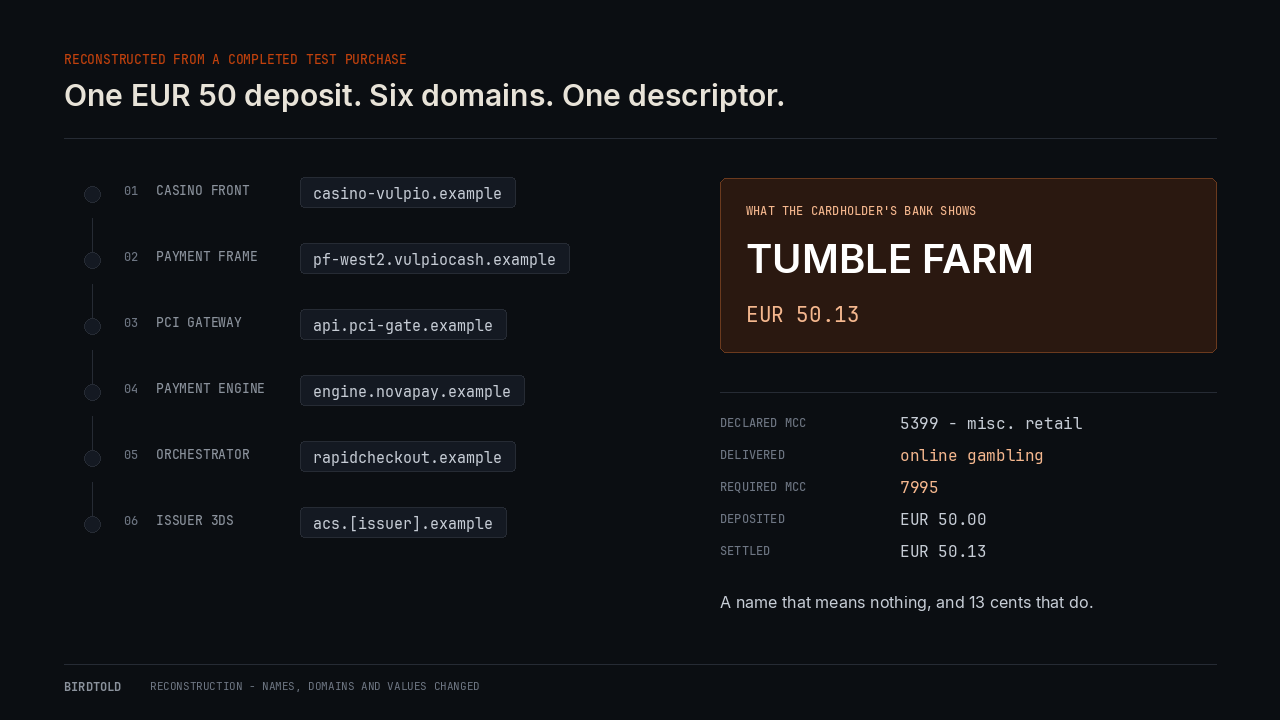
Two operators. One orchestrator. One attribution.
- starcove-play.exampleoperator a
- pf-west2.starcovecash.examplepayment frame
- api.pci-gate.examplepci gateway
- meridian-slots.exampleoperator b
- pf-west1.meridiancash.examplepayment frame
- engine.novapay.examplepayment engine
rapidcheckout.exampleshared orchestrator
Obligations
Your deadlines, dated.
These are not our claims. They are dates already binding the institutions reading this page.
In force
- 01 Jan 2026Mastercard merchant-monitoring requirements effective; violations reportable within five business days.Binds — AcquirersSource — Mastercard Security Rules and Procedures — Merchant Edition, §7.2.1, 4 Aug 2026, p.82 (verified 2026-08-09)
- 01 Jan 2026Sweden's payment prohibitions on unlicensed gambling take effect.Binds — Banks and PSPsSource — ICLG — Gambling Laws and Regulations, Sweden (verified 2026-08-09)
- 01 Jan 2026Visa Integrity Risk Program — high-integrity-risk merchant registration and monitoring obligations apply to acquirers, with MCC 7995 in Tier 1.Binds — AcquirersSource — Visa Integrity Risk Program (verified 2026-08-09)
- 19 Jun 2026Brazil Decree 13,033 — 24-hour account freezes on illegal betting flows.Binds — Financial institutionsSource — Decreto 13.033/2026, Planalto (verified 2026-08-09)
Upcoming
- 28 Aug 2026Brazil CMN Resolution 5.320/2026 enters into force.Binds — Financial institutionsSource — Resolução CMN 5.320/2026, Banco Central do Brasil (verified 2026-08-09)
Standing exposure
Visa's Integrity Risk Program assesses USD 25,000 per merchant for name or MCC manipulation, and USD 50,000 to USD 400,000 per merchant or URL for processing illegal transactions.
Visa Rules, public editionAll entries last verified 2026-08-09
Independence
We process no payments and take no revenue from any party we investigate.
Collection is capped at minimal value, fully audit-trailed, and our analysts stay unnamed because they are the instrument.
Every party named in a filed attribution gets a right of reply, and it travels with the finding.
Signals
The outside world, moving.
Curated, not aggregated. Four most recent; the record is at /news.
Upcoming — Brazil
Brazil's freeze mechanism becomes operational in three weeks.
28 AUG 2026 — Resolução CMN 5.320/2026, Banco Central do Brasil ↗Enforcement — Italy
Italy blocks 190 more gambling domains. The list now runs past 12,600.
05 AUG 2026 — ADM inhibition decree, as reported by AGIMEG ↗Scheme rules — Global
Mastercard's scam-merchant programme is now enforceable. Acquirers have 72 hours.
24 JUL 2026 — Mastercard Security Rules and Procedures — Merchant Edition, §7.2.1 Potential Scam Merchant Investigation Requirement, 4 Aug 2026, p.82 ↗Supervision — Sweden
Sweden's regulator reports supervision cases against payment intermediaries.
23 JUL 2026 — Spelinspektionen ↗The weekly filing
One email a week.
No product news. No marketing.
Double opt-in — unsubscribe in every send — Privacy
Telegram
Same items, as they publish.
A read-only channel. No group, no discussion, no direct messages.
Open the channelOpens telegram.org — nothing is loaded from Telegram on this page
Bounty
You have seen a cashier we have not.
Reached a card checkout at an operator that should not have one, or seen what landed on the statement? Tell us. Reports are read by hand.
No account needed · Telegram or email · Nothing published without your agreement